The BA oil sensor is an instrument that detects and measures the amount of oil in water and compares the results with a threshold value. This threshold value can be adjusted to any level between 2 and 500 parts per million (PPM) from the factory and at such values required by local and international regulations. Samples are taken at a frequency which complies with marine sampling standards. An alarm relay or 4-20mA output is provided, and activated when the measured oil concentration is higher than the factory preset value. The Intell-i-Watch can accommodate Either input from the BA sensor. Many options can be provided such as extended temperature range, explosion proofing and local ppm display.
Mounting Reference
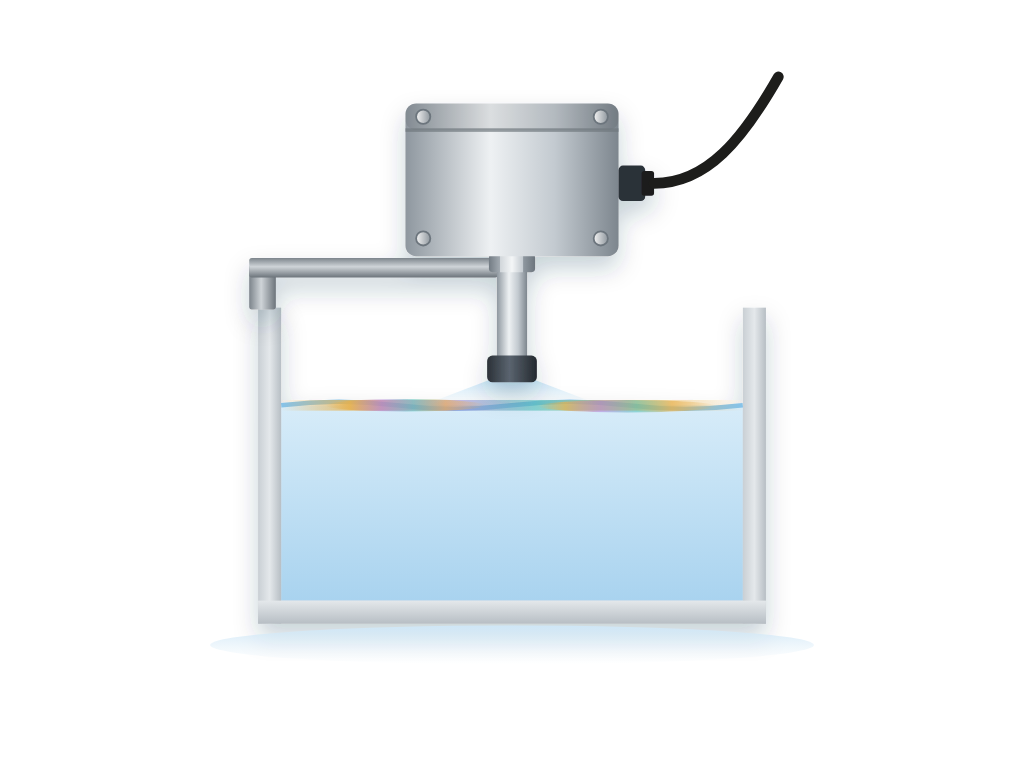
Inline 2” tee mounting: The sensor is installed into a water line with a 2-inch internal diameter tee that is welded or threaded into the line. Although it may be mounted in any orientation, it is suggested that it be mounted horizontally with the name plate on top. The flange is located on the tee so that when the probe body is inserted, it will protrude 1/4 to 1/2 inch into the inside diameter of the water line. In the design process, ensure the sensor will never sample air and be far enough down the line so that any air bubbles generated by a pump have time to dissipate. This may mean in gravity systems the installation of the unit be at a low point in the pipe run or installed in a "trap" arrangement. Sediment build up will shorten the life of the seals. Ensure that the Sensor opening is clear of any protective covering such as tape. The flanges are then bolted together.
Calibration: The sensor has been calibrated at the factory to your specifications. There is no need to re-calibrate the unit during pre or post installation. Attempts to re-calibrate the unit may lead to voiding of the warranty
General Theory of Operation
The sensor measures the concentration of oil in water. It is housed in an enclosure and sealed and bolted to a probe body and flange assembly. A mechanical assembly driven by a 7 RPM motor moves samples into and out of a sample chamber. The sample chamber is located in the probe body and contains a light source, sensor cells and a temperature compensating device. An electronic printed wiring board and power supply board perform the electro-optic calculation of the concentration of oil in water. These are the basic elements that measure the concentration of oil in water.
Within the sensor probe, light is directed into a chamber filled with a sample. The light is measured by two photo devices, which transform light into electric current. One cell, the transmit photocell, is situated so that light from the sensor's lamp can reach it directly. The second cell, the scatter photocell, is in the shadow of a light-absorbing pin, the occluding rod.
When the sample is clear, that is, when no oil is present, light from the lamp reaches the transmit cell unimpeded; no light reaches the scatter cell, which remains in the shadow cast by the occluding rod. When oil is present in the sample, the light is scattered by oil droplets and reaches the scatter cell. The angle between the transmit cell and the scatter cell favors the refraction angle for oil and tends to ignore the random scattering of particulate. As the concentration of oil in water increases, more light is scattered away from the transmit cell to scatter cell. The amount of oil in water is given by the ratio of scattered light to transmitted light. But since temperature differences affect photocell response, a temperature compensating Thermistor calibrates this ratio by correcting for discharge temperature changes. The sensor electronic board converts the electronic signals from the photocells to a voltage between 0 and 7 volts, which is proportional to the concentration of oil in water. To ensure that the oil in water concentration measured by the probe is the same as the concentration in the discharge line, the probe piston draws in and ejects a sample from the sampling probe chamber seven times a minute. The piston, which is driven by a gearmotor turning at 7 RPM, automatically wipes clean the window that covers the sensor lamp and photocells.
Operation
The sensor has no operator controls. If the set point for the oil in water concentration is exceeded, a local pulsating buzzer is sounded, red indicator light is lit and outputs activated. The red indicator light can be observed at the back of the unit, a few inches above the knurled nut that holds the cover in place. External alarms and indicators are the responsibility of the user.
To increase the life of the sensor, the unit should not be run dry for extended periods of time. Another way to extend the life of the unit is to slave the sensor to the pump or whatever is driving the water through the line or tank.

Intell-i-Watch multi-sensor transmitter monitoring systems are designed and supported by Pan America Environmental, Inc., with over 35 years of experience in industrial water and wastewater treatment.